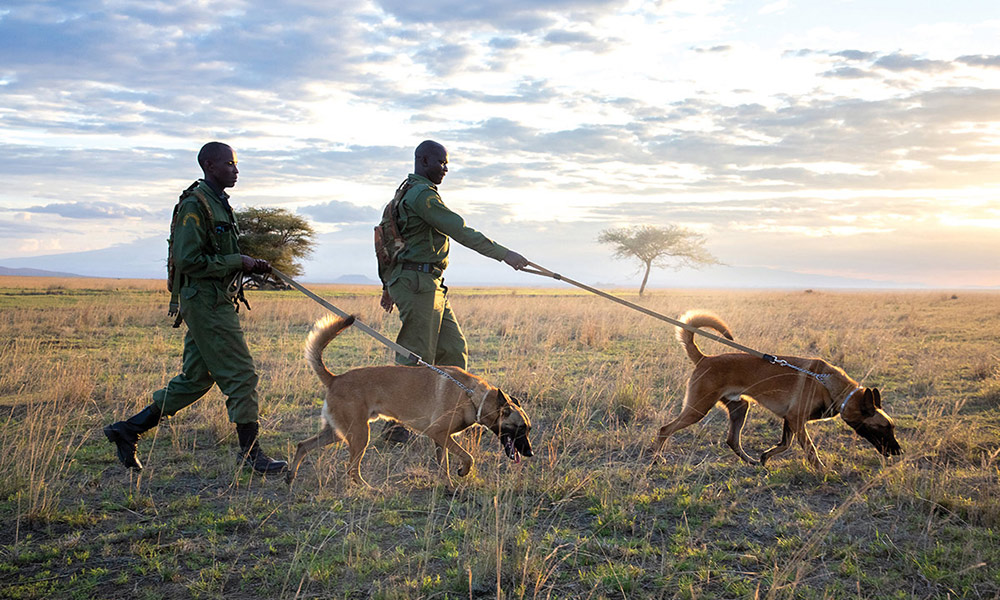
We are thrilled to welcome Holmes and Watson back from their training at the impressive Kuru ‘The Conservation Dog’ School in Arusha, Tanzania. They’re now actively integrating with our dog handlers based at Big Life’s Headquarters in Kenya.

Over the second quarter, Big Life’s ranger teams have responded to a noticeable uptick in bushmeat poaching incidents—an unfortunate reality during times of economic hardship. Our rangers, drawn from the very communities most affected, have been relentless in their patrols, arrests, and community outreach, all while navigating the complex dynamics that drive these offenses. Thanks to their vigilance, numerous illegal activities were intercepted, and the lives of countless wild animals spared.
At the same time, we’ve seen a promising trend: fewer crop raids by elephants, largely due to consistent and widespread rainfall last Spring. When water and food are readily available in the bush, conflict between people and wildlife decreases—a welcome reprieve for both. However, this doesn’t mean our work slows down, especially as the dry season sets in. If anything, it underscores the urgent need to secure and protect critical wildlife corridors and habitats, ensuring that as Amboseli’s wild inhabitants roam, they have the space they need to survive and thrive.
None of this would be possible without the steadfast support of our donors. You are the reason our boots stay on the ground, our vehicles stay moving, and our rangers stay watchful. Thank you for standing with us and with the communities who share their land with wildlife. Together, we are building a future where people and animals can flourish side by side.
Benson Leyian
Chief Executive Officer –
Big Life Foundation Kenya
SEE THE FULL 2ND QUARTERLY REPORT
Photo: Joshua Clay

Being face-to-face with a lion will always send shivers down your spine. It’s quite literally human nature.
It’s part of the reason lions are always at the top of every safari “must-see”.
But here in Amboseli, lions share this land with people, many of whom keep livestock. For them, the reality of living side-by-side is far from magical.
This is because cows are the wealth upon which entire families depend. And the loss of just one cow is just as emotional as it is a financial strain.
This strain reached catastrophic levels in the early 2000s when lions almost completely disappeared from Amboseli due to retaliation by people for livestock losses. At the time, the negatives of living with lions far outstripped the benefits. Lions account for more than 60% of attacks on cows by wild predators in Amboseli.
The bottom line is simple: people must benefit from living alongside wild animals.
As a result, we established our Predator Compensation Fund. We give an average of $114,000 dollars each year in compensation to livestock owners who suffer losses to predators.
The program is collaborative, with checks and balances. Thanks to our compensation program, along with the dedicated conservation efforts of other partners like Lion Guardians, Amboseli has become a stronghold for lions, with the population now at a healthy level of approximately 250.
We need the support of people like you to ensure we can keep these programs running.
If you care about lions, please consider donating to Big Life today for World Lion Day.
📸: Joshua Clay

We know it’s not polite to stare, but for this male giraffe we’ll make an exception.
Spotted last week, this individual is remarkable for two reasons other than the obvious: his crooked neck.
Firstly, this is not a new injury. We know this because Phillip Briggs of Lion Guardians photographed him back in 2019. That means this giraffe has been walking around like this for at least six years – and possibly longer.
Secondly, this giraffe appears to be in very good condition despite his wonky upper half, indicating this deformity has not dramatically disadvantaged him.
This is not the only documented case of a giraffe with a wonky neck, but instances like this are still extremely rare. Possible explanations for his condition range everywhere from scoliosis, torticollis, or a nasty fracture.
It’s hard to believe, but across Africa, giraffe populations are declining. Yet here in Amboseli, they are stable. Our holistic approach to community engagement and ecosystem management benefits species like giraffes who suffer from poaching and habitat loss.
Our mission allows individuals like this one to live out their lives as naturally as possible.
Please consider supporting Big Life today and keep giraffes like this unusual fellow protected.
📸: 2019 - Phillip Briggs
📸: 2025 - Joshua Clay
Page 13 of 116