Big Life Foundation

DONATE

Big Life Foundation

GET UPDATES DONATE

Big Life Foundation

GET UPDATES DONATE

  • WHAT WE DO menu down arrow
      • Back
      • PROGRAMS
      • rangers
        WILDLIFE
          PROTECTION
      • PROGRAMS
      • WILDLIFE PROTECTION
      • ANTI-POACHING
      • WILDLIFE CRIME /
            ANTI-TRAFFICKING
      • RHINO PROTECTION
      • TRACKER DOG UNIT
      • Back
      • Lions
        HUMAN-WILDLIFE
          CONFLICT
      • HUMAN-WILDLIFE CONFLICT
      • PREDATOR COMPENSATION
      • MAASAI OLYMPICS
      • HUMAN-ELEPHANT
            CONFLICT MITIGATION
      • Back
      • habitat
        HABITAT
          PROTECTION
      • HABITAT PROTECTION
      • Securing Wildlife Habitat
      • Rangelands Management
      • REDD+ Carbon Project
      • Back
      • Student
        COMMUNITY
         
      • COMMUNITY
      • Education
      • Healthcare
  • HOW WE DO IT menu down arrow
      • Back
      • THE RANGERS
        rangers
      • The Rangers
      • Back
      • PARTNERS
        elephants
        FINANCIALS
        zebras herders
      • Partners
      • Financials
  • WHERE WE WORK menu down arrow
      • Back
      • INTERACTIVE MAP
      • INTERACTIVE MAP
        Area of Operation
  • WHO WE ARE menu down arrow
      • Back
      • Big Life Kenya Big Life Kenya
      • Big Life USA
      • Big Life Canada Big Life Canada
      • Big Life UK Big Life UK
      • Back
      • About Big Life
      • Mission & Vision
      • History
      • Awards & Recognition
      • Back
      • Co-Founders
      • Ambassadors
      • Contact Us
  • PROGRAM UPDATES menu down arrow
      • Back
      • BIG LIFE NEWS
        rangers elephants
      • Big Life News
      • Photos From The Field
      • Short Films Gallery
      • In the Media
      • Operational Reports
      • 2025 Impact Report
      • Radio Room
      • Back
      • 2025 IMPACT REPORT
        Operational Reports
      • Back
      •  PHOTOS FROM THE FIELD
         SHORT FILMS GALLERY
        IN THE MEDIA
        OPERATIONAL REPORTS
        RADIO ROOM
  • SHOP menu down arrow
      • Back
      • BLF Shop
        BIG LIFE
        MERCHANDISE
      • Big Life Merchandise
  • GIVING menu down arrow
      • Back
      • Giving Essentials
        Manage Your Monthly Gift
        Give Monthly
        Start a Fundraiser
        Gift Catalog
      • GIVING menu down arrow Essentials
      • Manage Your Monthly Gift
      • Give Monthly
      • Gift Catalog
      • Start a Fundraiser
      • IRA Charitable Rollover
      • Stock Gifts
      • Leave a Gift In Your Will
      • Other Ways to Give
      • Back
      • IRA Charitable Rollover
        Stock Gifts
        Leave a Gift in Your Will
        OTHER WAYS TO GIVE
  • BIG LIFE MERCHANDISE
  • GET UPDATES
  • DONATE

A GIRAFFE IS NOT A GIRAFFE

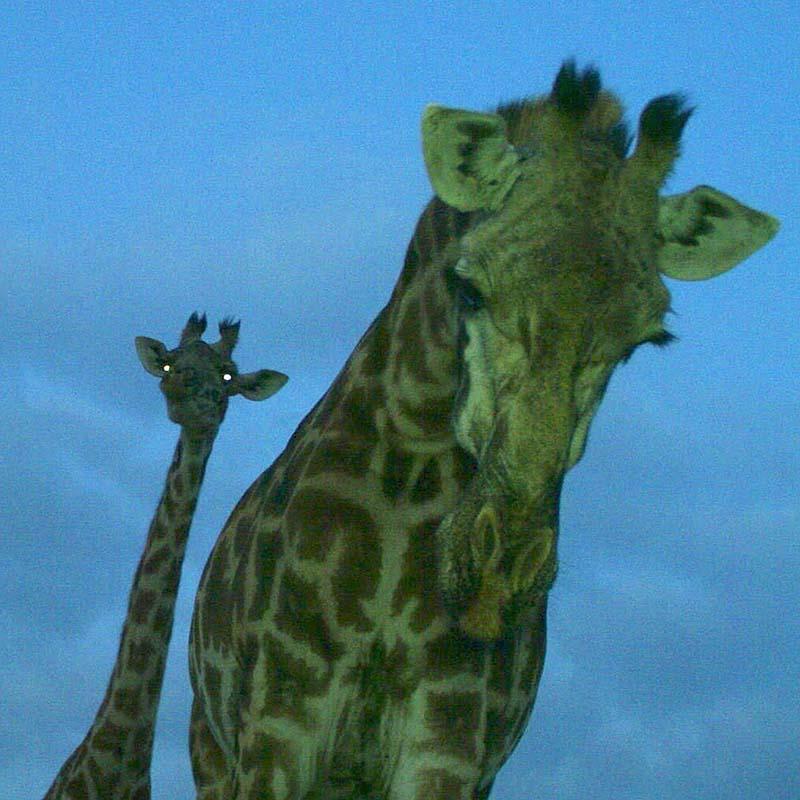
Giraffe in East Africa at dusk

Or is it? As strange as it sounds, opinion is divided. The consensus has long been that there exists one species of giraffe, divided into nine sub-species, but recent genetic research disagrees, and there may actually be four species of giraffe.

While the discussion continues, so does the population decline, and regardless of whether you call it a ‘species’ or a ‘sub-species’, the Masai Giraffe is the latest to get a very poor prognosis.

‘Endangered’ to be specific, according to the latest assessment by specialists for the IUCN Red List, as a result of the more than 50% decline in the last three decades, from approximately 71,000 to 35,000. Things do not look good for the Masai Giraffe.

Unless, that is, you’re living in the greater Amboseli ecosystem. We are always proud to report that a variety of wildlife species living in Big Life’s operating area are bucking continent-wide trends, Masai giraffes in a rather dramatic fashion. Aerial counts indicate a 24% increase in the population between 2013 and 2018, which stood at 5,312 at the last count.

There is no shortage of threats – ranging from habitat loss (land conversion to agriculture and cutting of trees for charcoal) to poaching (giraffes are highly desired in the bushmeat trade) but thanks to the efforts of Big Life and our ecosystem partners, Amboseli has become one of the strongholds of this species (or sub-species).

It is likely that the continent-wide decline of all giraffe populations will continue, as suitable habitat is consumed by Africa’s fast growing human population. As this happens, healthy giraffe populations such as that of Amboseli become the buffer against extinction, making our work more important with each passing day.

Such work needs your help, and you can make a difference today by making a donation or by joining the Ranger Club with a recurring, monthly gift. Thank you all for your support.
A MOTHER’S WORST NIGHTMARE

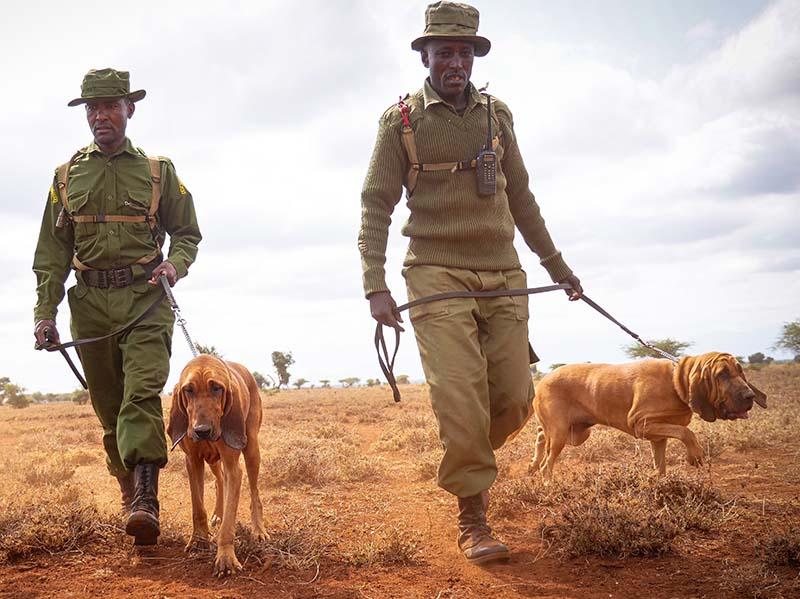
190726 Big Life Tracker dogs search for lost person

There is almost nothing worse for a parent than to turn around and find that your child is missing. This was the awful situation one evening in a remote part of Big Life’s operating area. A four-year-old boy playing close to his home had ventured a little too far into the thick bush, and was swallowed up by the wilderness beyond.

The family searched, hopeful that the child had not strayed far, but as time dragged on, panic set in. Sunset came and darkness fell, and the alarm was sounded far and wide. Big Life rangers responded, as did everyone in the village. A small child is easy prey for a number of nocturnal wild animals, and the search parties didn’t sleep, but still there was no sign of the missing child.

Morning arrived, and with it came the Big Life tracker dog unit. The rangers started walking in increasingly large circles around the home until they eventually found tracks some 3 km away. The dogs and their handlers set off, trailed by more than 100 local community members. They followed the tiny footsteps for a further 5 km, as they wound disoriented through the thick bush and completely in the wrong direction.

The steps eventually stopped at a wall of sharp rock covered in thick bush. The child had clearly been confused by the obstruction, and the footprints zig-zagged this way and that, misleading human and canine seekers alike. This went on until the dogs stopped, as they would if the job was done, but there was nothing to see. The community members started to split up and search, desperate now. It was mid-afternoon, and if the child was still alive, it was unlikely that he would survive a second night.

Just then, a small figure rose from beneath a bush not 100 m away, frightened but unharmed. The young boy had tired of walking and laid down, and would likely never have been found were it not for the efforts of Big Life’s rangers and tracker dogs.

The resulting celebrations were just one example of many; in the last year alone, Big Life community rangers have found and rescued 17 people lost in the wild, usually the very young or very old. For a ranger, helping the people around you is just as important as catching wildlife criminals, and the support of our local communities is one of the central reasons for Big Life’s conservation success, so these victories are truly a win-win.

As we look forward to World Ranger Day, we thank those men and women who dedicate their lives to protecting not only animals, but also the people who share the same beautiful spaces.

Please show your support for Big Life rangers by joining our Ranger Club. A monthly donation, no matter how small, helps provide consistent funding our rangers can rely on.

New Ranger Club members during the month of July (or existing members who increase their giving level) are eligible to receive a limited edition Big Life tote bag.

Director's Note - Q2 2019

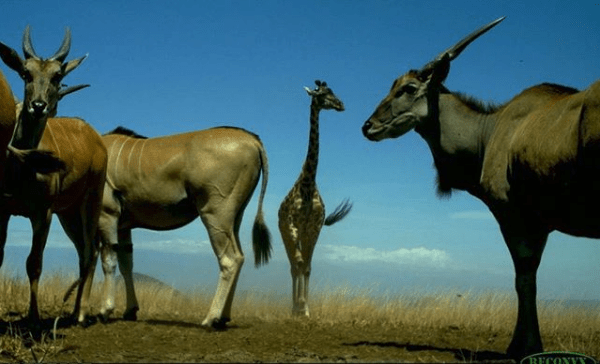
190719 DN camera trap

It is always a surprise this time of the year to realize that we’re halfway through it already. In the bush, there’s a steady stream of incidents to respond to, wildlife to assist, and community issues to help sort out. The seasons are marked by the rains, or sometimes lack thereof, and the green landscape that hopefully comes with them.

We got some rain in the second quarter, but not enough. The land has already shifted back to dry season conditions, and with it have come the usual complications. We can only hope that the abundance of rain from last year will carry us forward. In the meantime, the watering holes are looking a bit crowded.

Speaking of crowds, we are practically tripping on lions. If the pun can be forgiven, I’m quite proud of the large prides we’re now seeing on Maasai community lands. Twenty years ago, a lion sighting was an extremely rare thing; retaliation by local community members was high for depredation of livestock and ingrained social norms, so the lions kept their distance. The handful of lions that survived these retaliatory attacks hid in the lava in the hills around my home.

Now with predator compensation available for local livestock owners, and shifting attitudes thanks to the Maasai Olympics, as well as the work of our local partners, our lion population has rebounded to upwards of 200 in the ecosystem today—roughly 10 times as many as when we started. And quite a few them enjoy the grassy fields that are my back yard, much to my dogs’ dismay.

We’ll be hearing a lot about lions in the coming weeks thanks to a certain movie I hear is being released. We are grateful to our partners at the Disney Conservation Fund for using this opportunity to support lion conservation. Maybe someday soon I can enjoy this re-envisioning of The Lion King, with vistas inspired by Big Life’s area of operation, with my own children. If I leave the bush in time to make it to a theatre, that is.

In the meantime, Big Life’s rangers will keep protecting the wildlife and wild lands of this magnificent ecosystem for the benefit of us all. To all of our supporters who make this possible, thank you.

Richard Bonham
Co-Founder and Director of Operations, Big Life Kenya 

Read the full 2nd Quarterly Report

THE (PREVIOUSLY SHORT) LIFE OF AN AMBOSELI LION

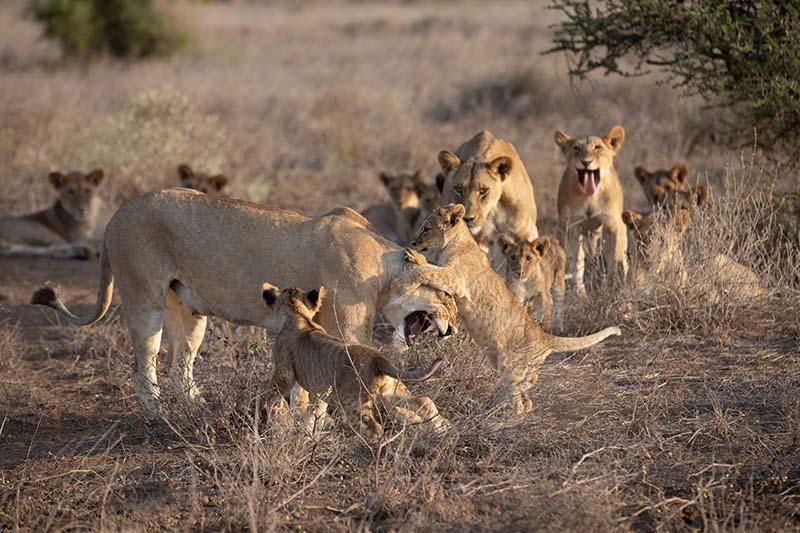
Lion family socalizing in Amboseli

For a lion born in Amboseli in the early 2000s, life was likely short. At least 108 lions were killed between 2001 and 2006, and that’s just counting the bodies that were found.

Maasai communities have historically killed lions, in retaliation for killing livestock as well as for cultural reasons, but in the Greater Amboseli ecosystem, losses used to occur at rates that the population could reasonably sustain. With the arrival of cheap and deadly agricultural poisons in the 1990s, that changed fast.

One person could easily wipe out an entire lion pride—and countless other animals, as well—with a single packet of poison, and the accelerated death rate left the lion population hanging in the balance, with as few as 20 individuals left alive at one point.

A local scientist wrote that one particularly bad month, during which more than a dozen lions were killed, “may represent the beginning of the end.” But local communities had other ideas, and Big Life took up the challenge.

In response to this urgent situation, we started the Predator Compensation Fund (PCF), aimed at reducing the economic losses associated with livestock depredation, and in each area where it was implemented, retaliatory lion killing immediately ceased.

At that time, there weren’t many lions left to kill, but thanks to our local conservation partners Lion Guardians, who have also made important contributions to protecting the species, we know that the lion population has grown steadily and is now in excess of 200 animals across the ecosystem.

During the worst of the killing, the lions who survived were those living singly or in small groups, those who avoided humans at all costs. The surviving lions hid themselves well. But with the reduction in persecution, stable prides have once again established.

It is a huge moment for us to report that there is currently a pride of 22 lions living entirely on Maasai community land. This is about as many lions in one pride as there were in the entire ecosystem 15 years ago. And thanks to this important cultural shift, the lions are calm and comfortable, allowing tourists on safari to get quite close, as this photo demonstrates.

This is only the beginning; conflict between lions and humans continues, and coexistence is uneasy. Big Life’s predator protection work is as critical now as ever, particularly as lion numbers continue to fall across the rest of Africa, and each population becomes a more important part of the whole.

However, it’s good to pause now and again and appreciate the results of all our hard work. In at least one small corner in Africa, the lion population is increasing, not decreasing, and that is worth celebrating.

Please help us to continue this success story by making a donation.

Photo: Andy Biggs

  • SURROUNDED BY SPEARS
  • CONSERVATION’S NEW BATTLEGROUND
  • GIRAFFE ON A MOTORBIKE
  • BORN TO BE BIG
  • A STORY FROM A HAPPIER WORLD
  • LUCKY LIONESS SURVIVES CLOSE SHAVE
  • A BANDIT’S HAVEN NO LONGER
  • Hope in Spite of Bad News
  • A Long-Awaited Journey
  • Director's Note - 2018 Annual Report
  • Poachers Caught Off-Guard in Northern Tanzania
  • Director's Note - Q1 2019
  • ELEPHANTS HAVE FACES
  • BACK TO BOOT CAMP
  • BABY ELEPHANT RESCUED FROM STICKY PREDICAMENT
  • THREADING ELEPHANTS THROUGH THE EYE OF A NEEDLE
  • DIRECTOR'S NOTE - Q4 2018
  • A TALE WITH A LIFESAVING TWIST
  • THE SIGNIFICANCE OF ONE YOUNG WOMAN’S 7 KM WALK
  • QUAGGA GREEN LABEL x BIG LIFE FOUNDATION 2019 PARTNERSHIP
  • A BIG MILESTONE FOR A BIG ELEPHANT - HAPPY BIRTHDAY TIM
  • 4th Maasai Olympics Highly Successful
  • Tough Love Tracker Dogs
  • The Equation That Doesn't Sleep
  • Working with Nature - One Heart Farm
  • Director's Note - Q3 2018
  • The Gold Rush
  • Mobile Care, Lasting Impact
  • One Step Closer to the Finish Line
  • Caught on Camera
  • A Herculean Effort
  • The Real Deal
  • WORLD LION DAY
  • DIRECTOR'S NOTE - Q2 2018
  • AT THE STARTING LINE TO SUPPORT THE FRONT LINE
  • TODAY, WE STAND WITH RANGERS
  • THE VOICE ON THE LIFELINE
  • NDERU – A TRUE ORIGINAL
  • Let the Games Begin!
  • BIG LIFE’S CANINE RANGERS
  • WHO IS THIS MAN?
  • TAKING THE PULSE OF AMBOSELI
  • THE TALLEST LAND ANIMALS
  • COMMITTED TO COMMUNITIES
  • DIRECTOR’S NOTE – Q1 2018
  • BABY STEPS TOWARD RHINO RECOVERY
  • DIRECTOR’S NOTE - 2017 Year in Review
  • HOW TO GROW A LION CUB
  • HONORING THE WOMEN OF BIG LIFE
  • THE LION SLEEPS TONIGHT
  • NEW FILM ON THE FENCE
  • LETTER OF APPRECIATION FROM KENYA WILDLIFE SERVICE
  • AN UPDATE FROM OUR DIRECTOR (Q4 2017)
  • A Memory of Elephants
  • WILD SHIRTS FOR WILDLIFE – ONE WEEK ONLY
  • EXPEDITION UNKNOWN with Josh Gates
  • Kenyan environmental tribunal protects open rangeland
  • From Poacher to Protector: Sergeant Mutinda Ndivo
  • Big Life Wins Rhino Conservation Award
  • STORIES FROM THE FRONTLINES: CORPORAL MEJAI OLE’KUMARI
  • STORIES FROM THE FRONTLINES: CORPORAL OLCHURIE KAPASEI
  • STORIES FROM THE FRONTLINES: CONSTABLE SESEI LOORMONI
  • Elephants in the Crosshairs

Page 102 of 118

  • 97
  • 98
  • 99
  • 100
  • 101
  • 102
  • 103
  • 104
  • 105
  • 106

Amboseli's elephants need your help
Our rangers are on the ground every day — removing snares, resolving human-wildlife conflict, and keeping herds safe. But we can't do it without support.
DONATE

Get Updates
From the field to your inbox: Program news, partnership opportunities, and exclusive event invites — delivered periodically throughout the year. No spam, ever.
SUBSCRIBE

FacebookLinkedInInstagramYouTube
 
FacebookLinkedInInstagramYouTube
 
Charity Navigator Four Star
Best in America
Candid Platinum Transparency 2026
Charity Navigator Four Star
Best in America
Candid Platinum Transparency 2026
Big Life Foundation USA
720 Seneca Street, Suite 107
Seattle, WA 98101
USA
info@biglife.org
+1 971 322 3326
Big Life Foundation Canada
17474 Humber Station Road 
Caledon Ontario L7E 0Z2
Canada
Canada@biglife.org
+1 416 624 6568
Big Life UK
c/o Chapel & York Ltd 
Unit 12 Ladycross Business Park 
Hollow Lane 
Dormansland 
Surrey RH7 6PB
United Kingdom
UK@biglife.org
Sign up for our e-newsletter
Learn more about our programs and partnership opportunities.
GET UPDATES
  •  Privacy Policy  •  Cookie Policy  •  Terms of Service  •  GDPR Compliance  •  Contact
Big Life is registered in the USA as a 501(c)(3) charity (EIN 27-3455389). Donations are tax deductible as permitted by law. BIG LIFE FOUNDATION® is a registered U.S. trademark of Big Life Foundation USA.
Donate