
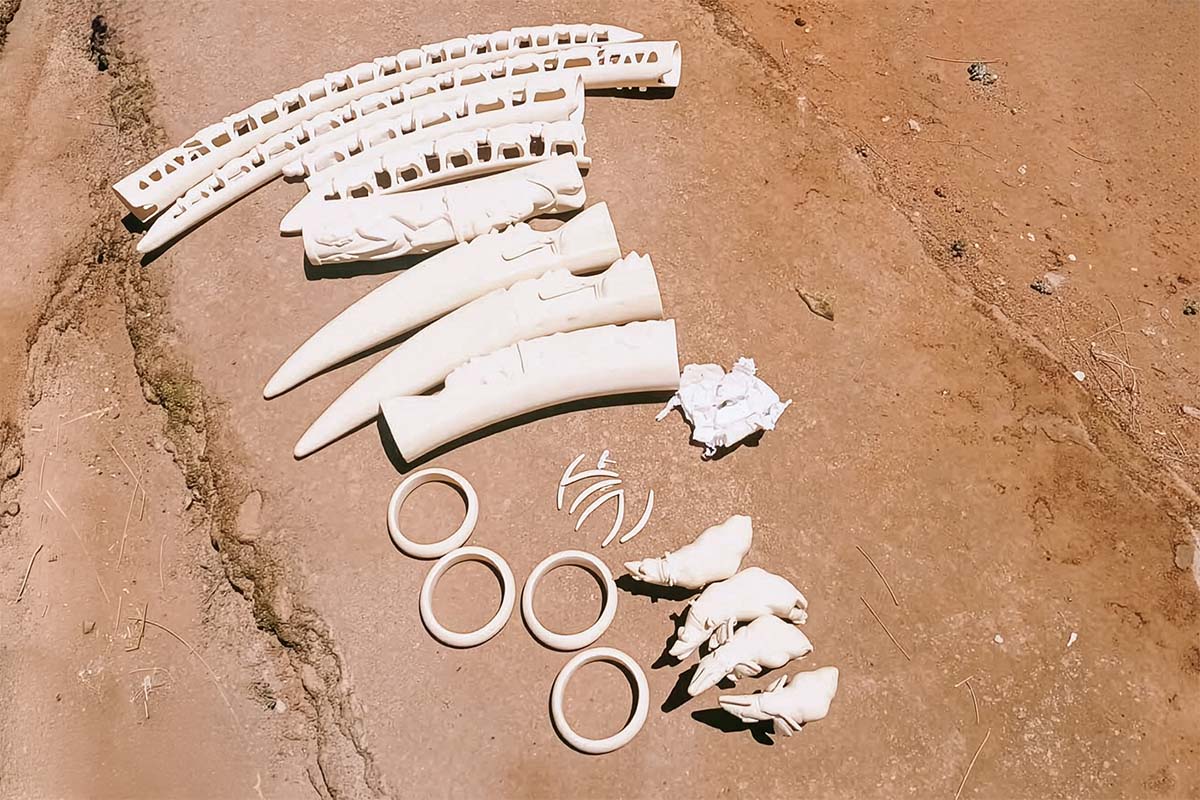
Three leopard skins, eight carved elephant tusks, four ivory sculptures, and four ivory bangles lay under the midday sun at Machakos Police Station.
It was an unusual haul.
Elephant poaching in Kenya has remained at relatively low levels in recent years, and many ivory seizures have involved unworked tusks believed to have been held for some time. So, these carved items seemed like relics from an even earlier era. But until our intelligence team knew more, they had to be treated as evidence of a potentially recent wildlife crime.
The investigation soon revealed a different story.
Two of the suspects had worked as housekeepers for a foreign national who left Kenya more than five years ago. The residence and its contents had remained largely untouched until earlier this year, when the third suspect persuaded the two housekeepers to try to sell the illegal wildlife items.
That’s when they came onto the radar of Big Life’s informer network.
After a series of exchanges, a meeting was arranged. Kenya Wildlife Service officers intercepted the vehicle, recovered the illegal items, and arrested all three suspects. They are now awaiting court proceedings.
Based on the information available, there is no indication that the ivory came from recently poached elephants. The leopard skins also appeared visibly old and sun-damaged.
The distinction is important, but so is the seizure.
Recent large ivory busts elsewhere in Africa and Southeast Asia have renewed concerns about the illegal ivory trade.
We haven’t lost a single elephant in our area of operation to ivory poachers since 2018, but that success is not a reason to become complacent. It’s a reason to keep the systems that helped achieve that success strong.
Old ivory can resurface. But the ongoing demand for it suggests elephants are still at risk.
Our rangers, as always, remain vigilant.